
Business ValueSolutionsHow It WorksBuilt CasesWhy IBDCPSecurityContact Assess the Business Case →

ONE TRUSTED DATA LAYER.

Across every system, partner and digital asset.

IBDCP turns fragmented data flows across enterprise systems, partners and distributed ledgers into verifiable business events — without replacing the infrastructure you already run.

Designed to reduce repeated integration and reconciliation work, strengthen auditability and enable automation on trusted data.

Evaluate IBDCP when: one critical process spans multiple systems or organisations and trust is still rebuilt manually.

IBDCPBLOCKCONTROL
Enterprise Systems
Partner Ecosystems
Digital Assets
Data Sources & IoT
AI Systems & Analytics
Distributed Ledgers
INTEROPERABILITYVERIFIABLE CUSTODYPROVENANCEDATA SOVEREIGNTYAI-READY EVIDENCE
Connected systems

CONNECT

Connect existing enterprise, partner, IoT and DLT environments without replacing them.

Verified trust

VERIFY

Create verifiable business events before data becomes a trusted record.

Traceable provenance

TRACE

Maintain provenance across systems, organisations and asset lifecycles.

Automated trusted workflows

AUTOMATE

Use verified data to trigger workflows, controls and AI processes.

Controlled data sovereignty

CONTROL

Exchange verifiable data while retaining control of your data domain.

Where the business case begins

The cost is in everything between your systems.

Most organisations do not lack systems. They pay for what happens between them: integration projects, reconciliation, duplicate verification, audit preparation and exception handling.

Every cross-system or cross-company handoff creates another trust decision: where the data came from, whether it changed, who accepted it and whether another party can verify the same evidence.

IBDCP is designed to make that trust decision once, cryptographically, and carry the evidence with the business event.

Decision signalIBDCP is worth evaluating when one critical process depends on multiple systems or organisations and trust is still rebuilt through integrations, reconciliation or manual evidence.
Assess this against your process
WITHOUT A TRUST LAYER
1System event
2Integration
3Reconciliation
4Partner check
5Verification
6Ledger / record
7Audit evidence
WITH IBDCP
ERP
IoT
API
DLT
IBDCPVERIFICATION & CUSTODY LAYER
✓ One verifiable business event
The commercial case

Turn integration friction into measurable business value.

IBDCP is relevant where trust gaps create recurring cost, delay, compliance exposure or prevent high-value automation.

Reduce integration overhead

Replace repeated point-to-point trust logic with a common orchestration and verification layer.

Reduce reconciliation work

Create shared, verifiable evidence as events move across systems and participants.

Shorten investigation & audit cycles

Maintain evidence from source through processing, acceptance and final record.

Enable trusted automation

Let workflows and AI act on data with verifiable origin, history and acceptance.

Preserve data sovereignty

Collaborate across organisations without surrendering control of source data or infrastructure.

Scale one trust layer

Extend the same architecture across more processes, partners, assets and business units.

One technology. Multiple high-value problems.

Apply IBDCP where trust has measurable economic value.

Start with the process where integration, reconciliation, provenance or cross-company trust is already costing money, slowing decisions or blocking automation.
Assess your use case →
Pharmaceutical and life sciences

Pharmaceutical & Life Sciences

Verify product and batch provenance across manufacturing, QA, release and logistics.

Explore Life Sciences →
Financial services and real-world assets

Financial Services & Real-World Assets

Link identity, ownership, asset evidence and transactions across traditional and distributed infrastructure.

Explore Financial Services →
Supply chain and manufacturing

Supply Chain & Manufacturing

Create one verifiable event history across suppliers, production, sensors and logistics.

Explore Supply Chain →
Government and critical infrastructure

Government & Critical Infrastructure

Exchange trusted records across institutions without forcing a single central platform.

Explore Public Infrastructure →
High-value and real-world assets

High-Value & Real-World Assets

Give high-value physical and digital assets a persistent, verifiable provenance record.

Explore Asset Provenance →
Built IBDCP cases

Six business models. One trust architecture.

Decision-makers do not need another abstract protocol diagram. They need evidence that the architecture can move from infrastructure into real workflows. These built cases apply IBDCP across digital assets, healthcare, AI, real-world assets, commerce and decision intelligence.
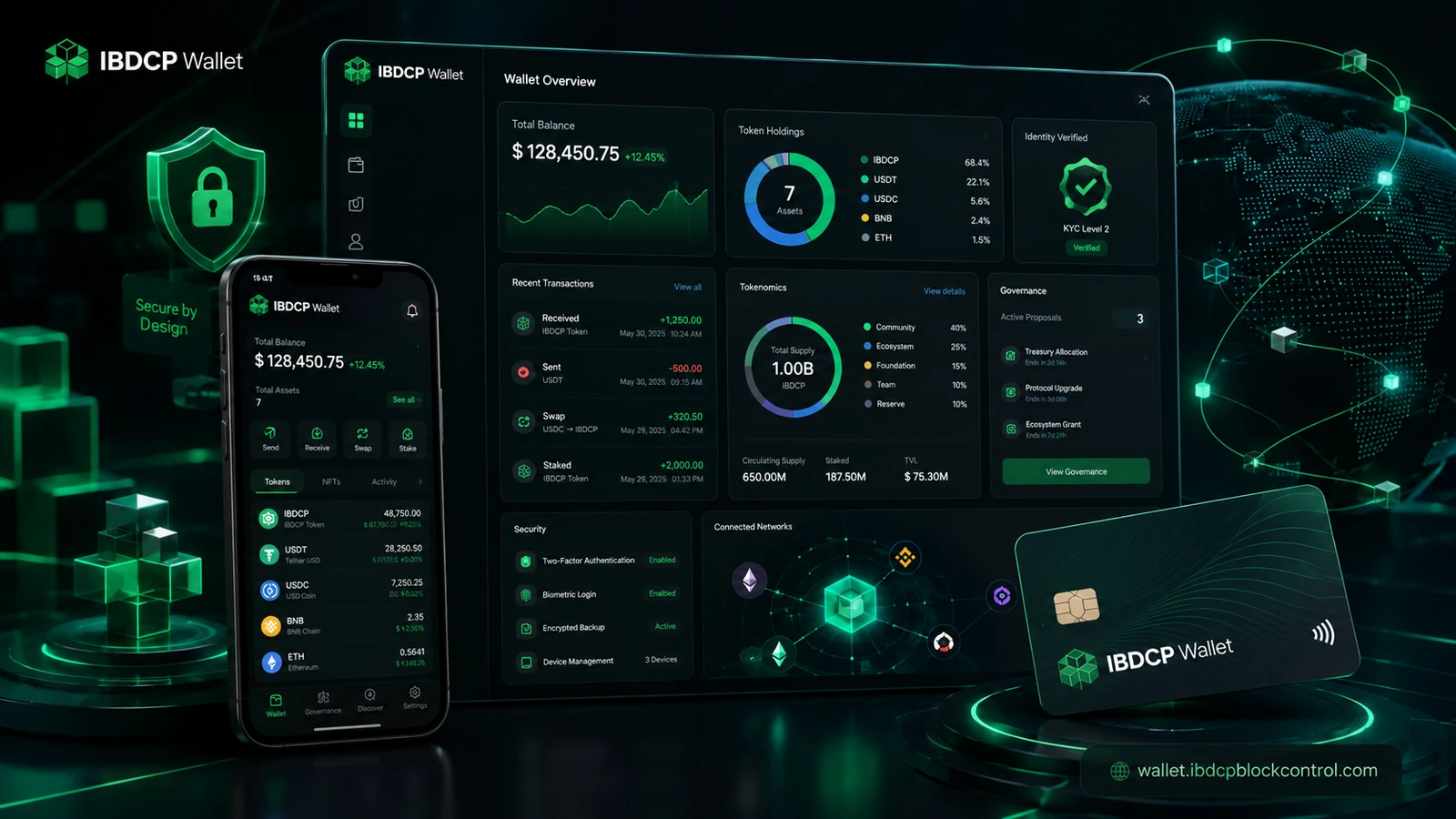
IBDCP Wallet blockchain, tokenomics, identity and digital-asset infrastructure dashboard

IBDCP Wallet — Blockchain & Tokenomics Core

Reusable wallet, identity and digital-asset core for upper-layer IBDCP applications and transaction flows.

Decision relevanceShows IBDCP can anchor user identity, wallet authority and digital-asset actions as shared infrastructure rather than rebuilding trust inside every application.
View implementation
eKarton healthcare platform with secure patient records and trusted IBDCP data exchange

eKarton.io — Healthcare on IBDCP

Healthcare implementation applying IBDCP to patient-centred digital records, identity and trusted data exchange.
Decision relevanceShows sensitive health workflows can retain domain-specific systems while adding custody, provenance and verifiable access evidence underneath.
View implementation
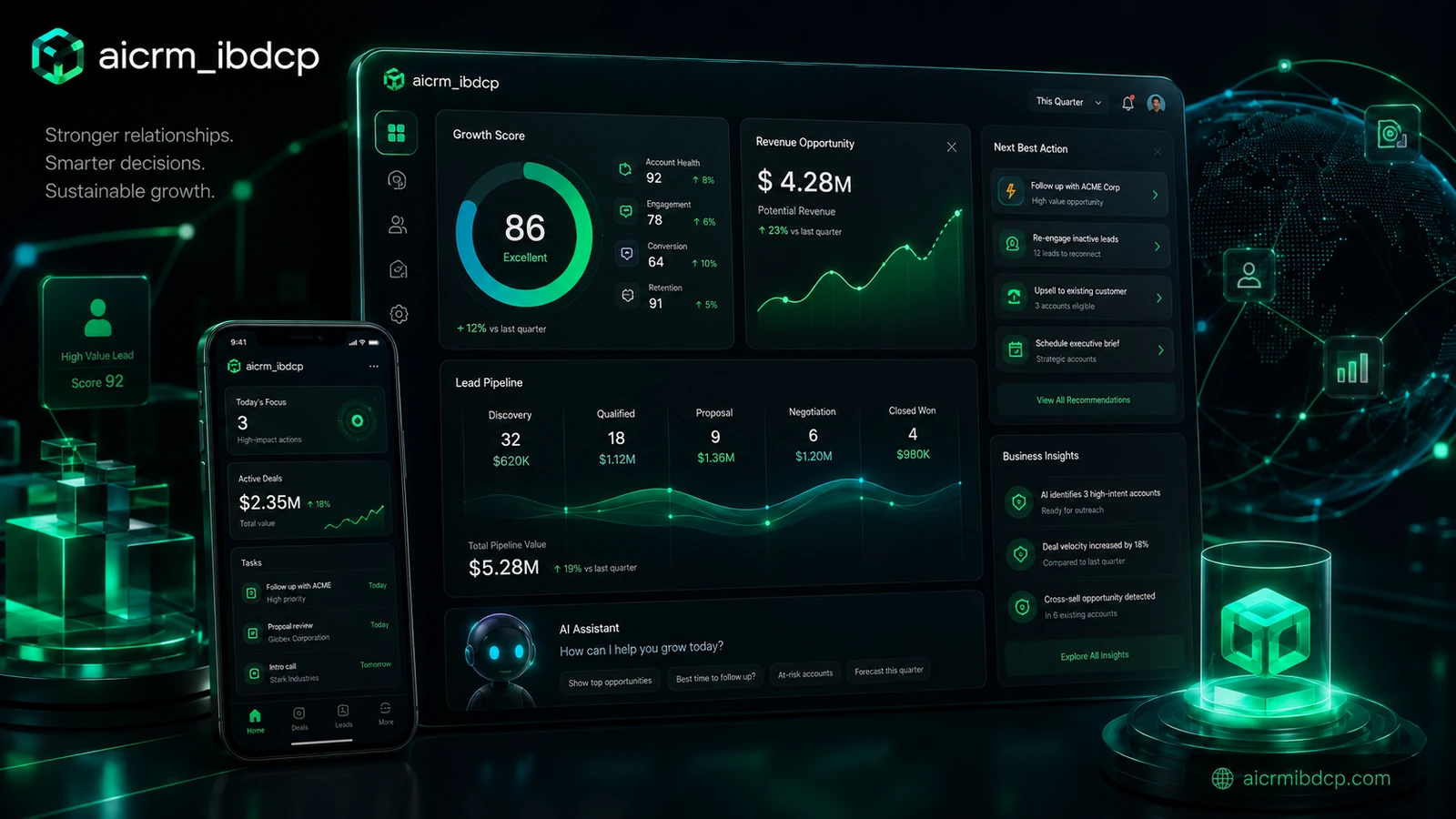
aicrm_ibdcp AI growth CRM dashboard for daily business decisions and opportunities

aicrm_ibdcp — AI & IBDCP CRM

AI and IBDCP-based CRM that turns contacts, deals, files and business portfolio data into daily growth actions for decision-makers.
Decision relevanceShows trusted business data can become operational decision intelligence — not only another dashboard or audit archive.
View implementation
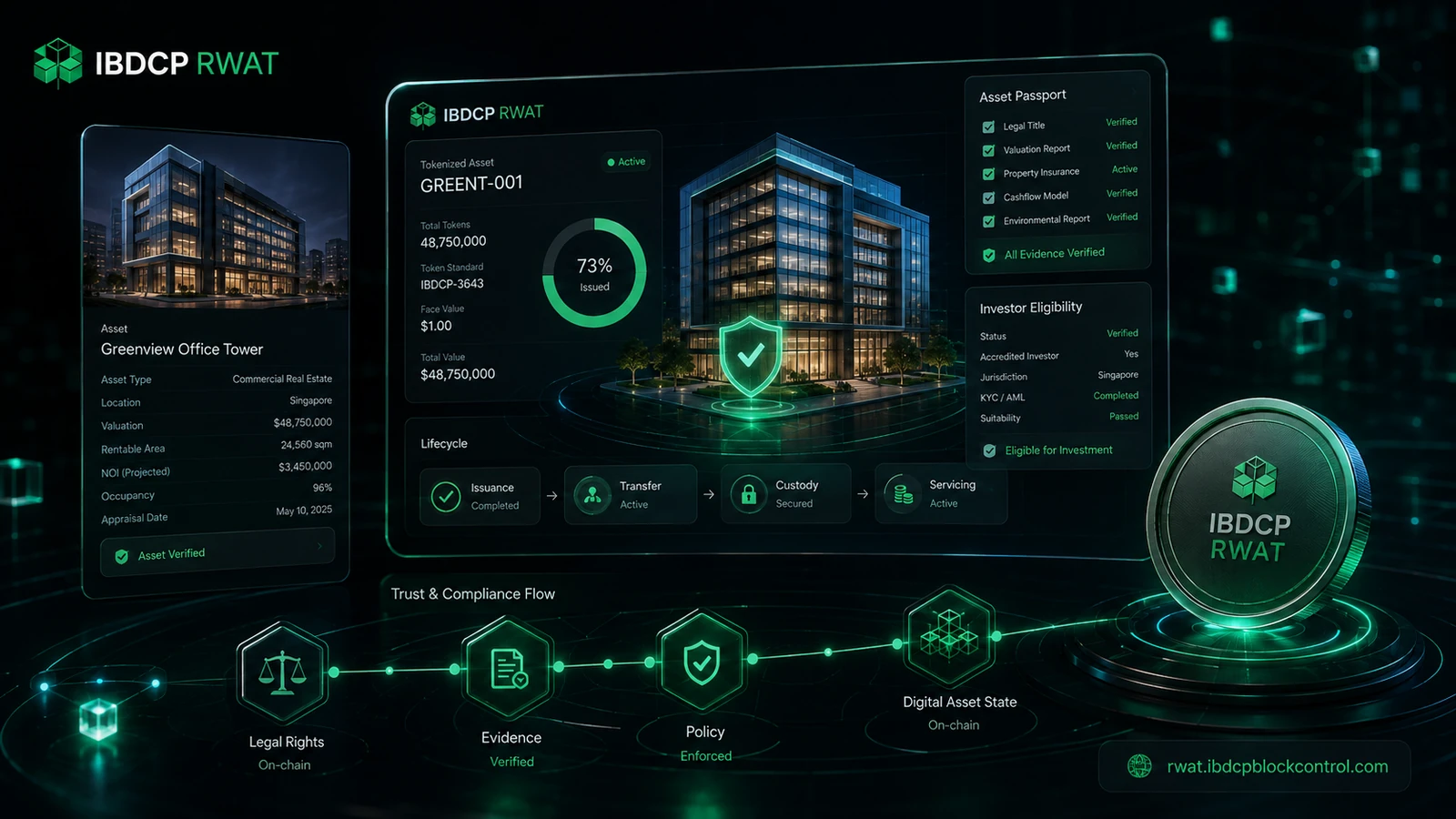
IBDCP RWAT platform showing tokenized real-world asset verification, eligibility, policy and lifecycle evidence

IBDCP RWAT — Governed Asset Lifecycle

Full operational RWAT platform connecting asset evidence, legal rights, investor eligibility, policy, issuance, transfer and lifecycle proof.

Decision relevanceShows tokenization becomes commercially credible when real-world authority, policy and digital state remain connected through the full asset lifecycle.
View implementation
Bedora ecommerce experience with IBDCP-backed digital product passport and product traceability

Bedora — eCommerce + Digital Product Passport

Customer-facing commerce with IBDCP-backed digital product passport capability linking product identity and traceability to normal buying flows.

Decision relevanceShows IBDCP can disappear into everyday user experience while still adding verifiable product evidence and lifecycle traceability.
View implementation
Verenyx decision intelligence platform with business context, evidence, confidence and next-action analytics on IBDCP

Verenyx — Decision Intelligence on IBDCP

Enterprise decision-intelligence tenant that connects company data and context, detects patterns and anomalies, estimates likely outcomes and recommends the next best action with evidence and confidence.

Decision relevanceShows the AICRM / IBDCP foundation can support a differentiated tenant product without rebuilding the trust layer — turning connected business data into decision intelligence for management.
View implementation
The decision pattern is consistent.When business value depends on proving identity, authority, provenance or state across more than one system, IBDCP becomes infrastructure rather than a feature.
Assess where your case fits
Why IBDCP

Interoperability alone does not create trust.

IBDCP combines connectivity with verification, custody, sovereignty and long-term security — so data can be acted on, not merely moved.
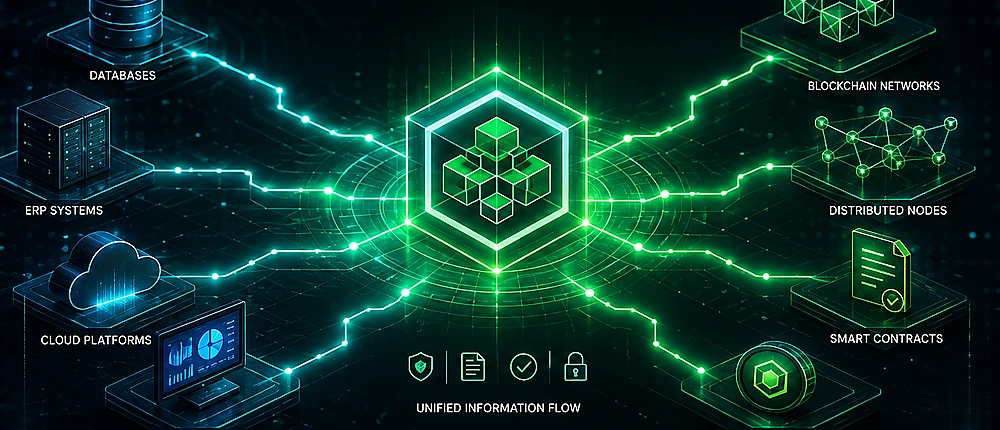
Interoperability between centralised and decentralised environments

Interoperability

Connect centralised and decentralised environments in one governed information flow.

Verifiable data custody

Data Custody

Keep verifiable evidence of origin, processing, acceptance and exchange with the event.

Adaptive consensus across systems

Adaptive Consensus

Apply the verification model that matches the participating systems, risk and business case.

Enterprise data sovereignty

Data Sovereignty

Share verifiable outcomes without surrendering control of your data domain.

Post-quantum-ready security

Post-Quantum-Ready Security

Design long-lived digital infrastructure for evolving cryptographic requirements.

AI-ready provenance and trusted data

AI-Ready Provenance

Give AI and automation traceable context so decisions can be audited back to source.

Security for decision-makers

If the trust layer is not independently defensible, it should not be deployed.

IBDCP security architecture combines zero-trust identity, protected institutional key custody, minimum-necessary data, tamper-evident evidence, cryptographic agility and versioned change control.

Review the Security Model
01

Keys

Institutional signing is designed for protected custody such as HSM/MPC — not exposed raw private keys in application workflows.

02

Data

Sensitive PII, KYC and business documents should remain off-chain; only the minimum verifiable evidence is disclosed.

03

Evidence

Signed and tamper-evident event records make the lifecycle independently auditable across systems and participants.

04

Boundary

IBDCP strengthens transaction-level trust but does not replace endpoint, cloud, identity, operational or jurisdiction-specific controls.

Moving data is not the business problem.
Proving it can be trusted is.
Can we prove the origin?
Can we prove who produced it?
Can we prove what changed?
Can we prove who verified it?
Can we prove where it was accepted?
Can another party verify the same evidence?
Start with one business decision

Decide in three steps: Assess. Prove. Scale.

Start with one process. Prove value against agreed criteria. Expand only when the business case, architecture and operating model are clear.

Executive assessment and discovery

Assess

Identify where fragmented trust creates measurable cost, delay, risk or blocked automation.
Focused IBDCP proof and pilot

Prove

Run a focused pilot against agreed business and technical success criteria.

Enterprise-scale deployment

Scale

Expand only after the value, architecture and operating model are proven.

Executive assessment

Decide if IBDCP creates value before you commit.

Evaluate one concrete business process against commercial value, architecture fit and a bounded proof path. The purpose is not to start a technology programme — it is to make a defensible executive decision.

Decision output Proceed. Refine. Or stop.

You leave with a defined business case, fit assessment, pilot scope, success criteria and the commercial route to production — or a clear reason not to proceed.

  • Quantify the business problem and target outcome.
  • Review the systems, participants and data flows involved.
  • Identify where IBDCP can create technical or commercial advantage.
  • Define the smallest pilot capable of proving the case.
  • Agree measurable business and technical success criteria.
  • Map the route from pilot to production and scale.
Assess My Business Case
Technology when you need the detail

Technical depth when your team needs to verify the decision.

Layer Zero ArchitectureDatafication PoolsAdaptive ConsensusMeta-RoutingData CustodyMulti-Ledger OrchestrationPost-Quantum CryptographyEnterprise IntegrationSecurity Architecture ↗Governance & Compliance Boundary ↗